



Major sporting events drove significant increases in Australian digital audiences in June, highlighting opportunities for publishers and advertisers to reach large audiences around live sports and news, according to June data from Ipsos iris, Australia’s digital audience measurement currency endorsed by IAB Australia.
The Sports category reached 14.1 million Australians aged 14 and over during June, an 8.1 per cent increase on May, with users spending an average of 56.6 minutes consuming sports content across websites and apps during the month.
The increase coincided with a month of major sporting events, including the FIFA World Cup, NBA Finals, AFL fixtures and Wimbledon. The figures illustrate how major events can concentrate audience activity across digital platforms, providing publishers with opportunities to attract audiences and advertisers with environments in which large numbers of users are actively seeking timely content.
World Cup drives audience spikes
According to the data, te FIFA World Cup was a significant driver of digital sports consumption in June, with audiences turning to websites and apps for scores, fixtures and live updates after the tournament began in Mexico City on June 11.
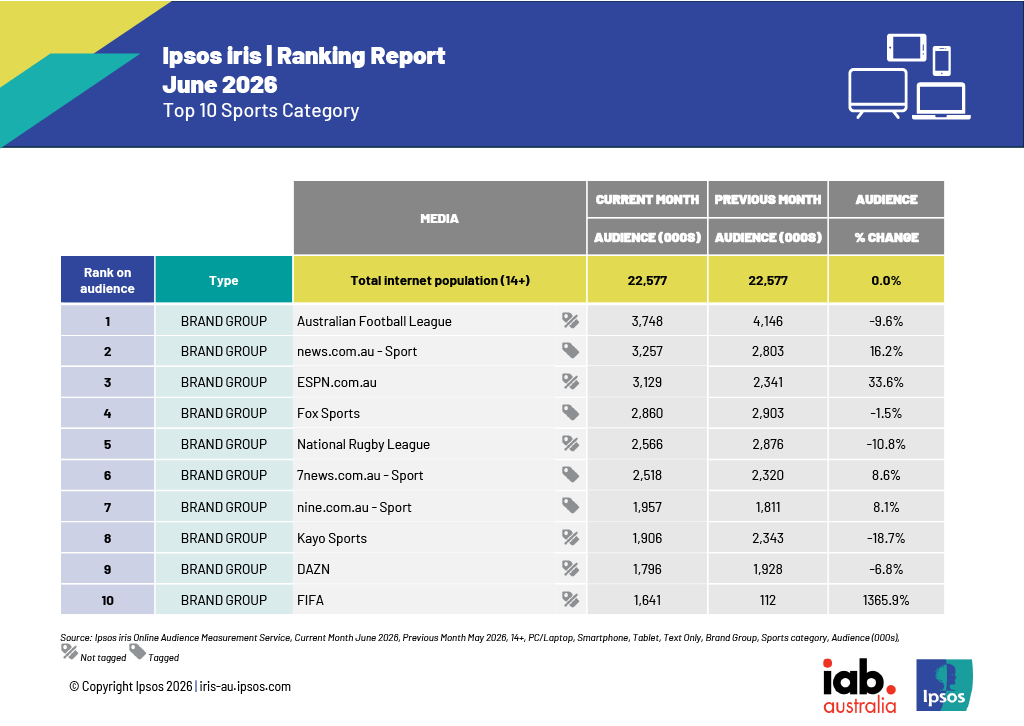
SBS Brand Group, which includes SBS websites and apps across PCs, laptops and mobile devices, recorded a 28.7 per cent month-on-month increase in its Australian audience, rising from 5.6 million to 7.2 million.
Figures show the SBS Sport audience increased from 59,000 in May to 716,000 in June, representing an increase of more than 11 times, according to Ipsos iris.
FIFA also recorded a substantial increase in Australian online audience numbers. The organisation’s audience grew from 112,000 in May to more than 1.6 million in June, while average minutes spent on the site increased by 65 per cent month-on-month.
The increases provide an indication of the audience concentration that can occur around major live events, particularly when users are seeking frequent updates and event-specific information.
The NBA Finals also contributed to digital sports consumption. ESPN.com.au recorded a 33 per cent month-on-month increase in its Australian audience, rising from 2.3 million to 3.1 million.
Meanwhile, Australian Football League websites and apps recorded the largest audience within the Sports category, reaching 3.75 million Australians during June. Users spent an average of about 36 minutes per person across the month.
Sports content also reached audiences across both genders. Monthly reach among men increased from 63 per cent to 70 per cent, while reach among women increased from 52 per cent to 56 per cent.
For advertisers, the figures highlight the scale of audiences available around sports content, while also showing that digital sports consumption extends across a broad demographic base.
News remains a major digital advertising environment
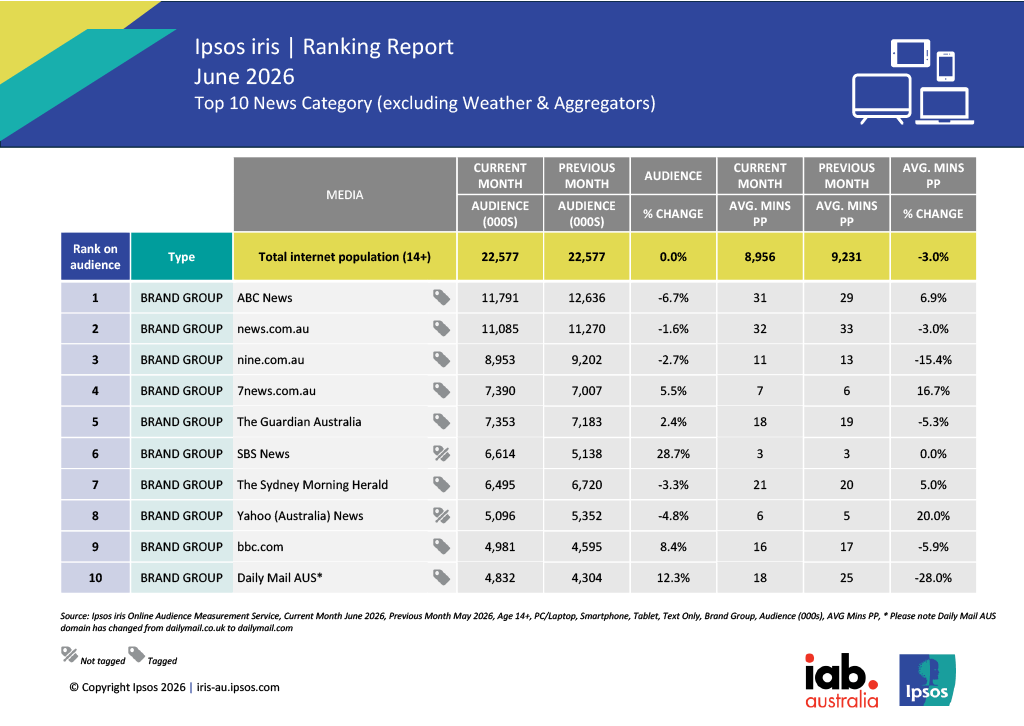
The audience opportunity extended beyond dedicated sports platforms, with news websites and apps reaching 21.6 million Australians in June.
According to Ipsos iris, news websites and apps reached 95.7 per cent of Australians aged 14 and over who were online during the month. Users spent an average of 3.12 hours consuming news online in June.
The FIFA World Cup was among the major subjects attracting attention across news platforms, alongside coverage of the NRL and State of Origin Game 2 in Melbourne.
A range of domestic and international stories also generated significant readership during the month. These included the Coogee shark attack, an Australian tourist charged in Thailand over an alleged “suitcase murder”, US politics and developments surrounding the conflict involving Iran.
Political and economic issues, including the Federal Budget, housing and tax changes and the financial wellbeing of homeowners, also continued to attract audiences.
Other major stories highlighted in the June data included Karl Stefanovic’s podcast appearance with political activist Tommy Robinson and his subsequent departure from the Nine Network, as well as international coverage of natural disasters, violence at a French music festival, the resignation of UK Prime Minister Keir Starmer and former Top Gear presenter Jeremy Clarkson’s cancer diagnosis.
The breadth of topics attracting audiences demonstrates the range of environments available to advertisers across digital news, from high-profile breaking news to ongoing political, economic and international coverage.
Audience scale provides context for digital advertising market
The broader Ipsos iris data shows the scale of the Australian digital audience available to publishers and advertisers.
A total of 22.57 million Australians aged 14 and over accessed the internet in June, broadly in line with the previous month, while average daily internet use was 4.97 hours.
The largest digital categories by audience were social networking, with 22.49 million Australians, followed by search engines at 22.48 million, online media at 22.46 million, technology at 22.4 million and entertainment at 22.19 million.
Several other categories also recorded year-on-year audience growth. Career increased 10.7 per cent, recording its highest year-on-year audience growth for the fourth consecutive month, while Travel rose 5.4 per cent. Energy Suppliers/Utilities increased 4.6 per cent, Homes and Property grew 3.57 per cent and Health increased 3.6 per cent.
IAB Australia said Ipsos iris provides an independent measurement of digital audience reach, characteristics, frequency and time spent across digital publishers and platforms.
The measurement currency supports the Australian online advertising market, which IAB Australia said was worth $18.4 billion in calendar year 2025, based on its Internet Advertising Revenue Report prepared by PwC.
Ipsos iris uses a hybrid methodology combining data from a nationally representative passive panel with site-centric census measurement. The system measures audiences across smartphones, PCs, laptops and tablets and is designed to address cross-device duplication when measuring online audiences.
According to IAB Australia, the June figures do not measure advertising outcomes directly, but provide publishers and advertisers with an indication of where Australian digital audiences were concentrated and how much time they spent consuming content.